Author Archives: smarcia12

Women in Sports: Role Models for Life

img_0739

One of my dearest, and most intelligent friends Sophia Arenas wrote the below article this summer: Women in Sports: Role Models for Life. She brought forth points that I often forget to consider when thinking about women as role models in sport. I think her statements are vastly important and worth sharing!

 “Historically in sports, women have had and continue to have many obstacles to overcome. They often have been scrutinized for their appearance; either criticized for their lack of femininity or hyper-sexualized in the media and on the cover of magazines. Before the passage of Title IX in 1972, about 1 in 27 women participated in sports. Today 2 in 5 women participate in athletics. Media coverage does not reflect this dramatic increase, however, and despite the drastic increase in participation rates female athletes are still covered less, and less seriously, than male athletes. For example, the US women’s basketball team won their fifth consecutive gold medal in 2012 at the summer Olympics but received less than half of a minute in prime-time coverage. The men’s team, however, who won their second consecutive gold medal, received approximately half of an hour of prime-time coverage (1).  

More recently, the U.S. Women’s soccer team (led by co-captains, Alex Morgan, Megan Rapinoe and more) filed a gender discrimination lawsuit in March 2019. As stated in the lawsuit, “…Despite the fact that these female and male players are called upon to perform the same job responsibilities on their teams and participate in international competitions for their single common employer, the USSF, the female players have been consistently paid less money than their male counterparts.”  This discrimination is not only apparent in terms of pay and media coverage, but also in terms of medical treatment, types of training and coaching they recieve, and means of transportation to matches, despite the U.S. Women’s National Team being world champions.

Over the years many women have paved the way for the next generation of athletes. They have been role models for little girls who have grown up watching them, even when the athletes didn’t realize they were being idolized. They are the pioneers who made it possible for contemporary sports stars like Serena Williams, Diana Taurasi, Megan Rapinoe and Alex Morgan. Although these women or athletes, in general, may not have signed up to be role models, the reality is that they are in the public eye and will be looked up to by a whole new generation of young girls.

Indeed, female athletes do serve as powerful role models for young girls; they promote a healthy lifestyle and participation in physical activity. Not only do female athletes promote a healthy lifestyle but also defy stereotypes of what society believes a female body should look like. They are strong, which sends the message to young girls that it is possible to have muscles and still be feminine. It shows young girls that their value as a woman is not defined by the number on a scale.

Females who participate in sports also develop important life skills such as confidence, dedication, leadership, the ability to work in groups, and more. Sports for many can be that initial platform where young people acquire these necessary tools to succeed in the world. However, in the past, boys were encouraged to participate in sports while females were encouraged to participate in more “gender appropriate” activities. Although the idea that sports should only be reserved for boys/men is certainly outdated, it has much to do with the efforts made by female sports pioneers who paved the way for the next generation. The media heavily influences how females participate and how they perceive their role in sport. Less than 10% of sports media covers women’s sports and less than 2% of sports media covers women’s sports that are deemed too masculine (2).

As a society we have made significant growth in our ability to value diversity; however, we still have a long way to go, especially regarding the #metoo movement.  Gender roles are deeply rooted in our culture; we see their influences permeate through sport every day. From the ground up young girls need to be offered the opportunity to participate in sports of all kinds – masculine or feminine. They need to be led by female coaches in order to foster their perception of their future selves. The media, being one of the heaviest influencers, needs to equalize their sports coverage and spotlight strong, elite female athletes. Without consistent exposure to the excellence of female athletics, the masculine-heavy perspective in sports coverage will never change. Leveling the playing field in sports could be a stepping stone to the ultimate goal: gender balance throughout wider society.”

  1. Coche, R. & Tuggle, C. A. (2016). The women’s Olympics?: A gender analysis of NBC’s coverage of the London 2012 Summer Games. Electronic News, 10(2), 121-138.
  2. Koivula, N. (1999). Gender stereotyping in televised media sport coverage. Sex Roles, 41(7), 589-604.

 

Keeping the Game in Check

Posted on

As we enter the Women’s College World Series of D1 NCAA softball, there is plenty of opportunity to watch elite athletes succeed and fail in the face of pressure. It’s make-or-break time; it’s win or go home. Athletes are facing some of the most difficult situations of their careers—everything is on the line, and they can taste that World Series championship.

An article was recently published with the title: “How Butterflies and TED Talks Boosted Georgia’s Alyssa DiCarlo.” The article sheds light on the pressures faced by successful athletes and how they effectively keep them at bay. (Read it here: 2019 NCAA softball tournament: How butterflies and TED Talks boosted Georgia’s Alyssa DiCarlo)

Alex Scarborough quotes DiCarlo’s experience growing up, stating, “Earlier in her career, she sometimes let nerves get the best of her. She had devoted everything to the sport—’It’s my life,’ she said. ‘I didn’t go to prom, didn’t go to homecoming. I didn’t do anything but softball’—and the idea of not living up to expectations made her timid on the diamond.”

As Scarborough points out, athletes who reach the collegiate level often miss out on other social opportunities along the way. Consequently, their evaluation of themselves is purely based on their performance in sports. When they fail in sports, they feel like a failure overall, as sports have become their entire life. Thus, failing in sports leads them to feel as though they are failing as individuals. It’s not just about failing on the field; it’s a much bigger issue for them. For this reason, it is crucial to provide young athletes with a healthy sport-life balance. Especially when they are young, they need the opportunity to develop all aspects of who they are. They require the space to explore their talents in music, school, friendships, and hobbies. By doing so, they can feel that they have value in various areas of life, allowing them to have other sources of confidence to fall back on in times of failure. If kids had these opportunities throughout their athletic careers, the pressure to perform would be significantly reduced. (I wrote a blog recounting my experience in having a healthy sport-life balance a while back, you can read it here: Keep a Sport-Life Balance)

In the article, DiCarlo is also quoted commenting on how her mental game has helped her succeed: “Being mentally tough,” she said, “keeping your emotions at bay is something I’ve had to work on a lot.” The mental game is often overlooked, especially by coaches of youth athletes. They may not have the training or experience to teach young athletes how to utilize their minds to excel. However, having an effective mental game is even more important than excelling; it can help athletes of all ages experience more joy while playing the game. Equipping athletes with the tools to deal with the high-pressure demands that come with being a competitor helps keep negative emotions at bay and allows more room for the positive ones to flourish.

Teaching athletes mental game strategies and giving them the room to explore their other talents can help to keep the game in check. Keeping the game in check has the potential to give athletes the best opportunity to fully develop into themselves, both as an athlete and a person.

Petaluma Embraces a Miracle League

Posted on

Fives years ago I had the opportunity to be a fan at the best baseball game I’ve ever seen. I was living in San Jose and working as an instructional aid to a 3rd grade boy who had the diagnosis of Spinal Muscular Atrophy. He played for the Challenger Baseball League which supported athletes who were differently abled. The experience of simply watching radiated happiness through my soul. Here is the article I wrote following the game:

An Unforgettable Atmosphere  May 10, 2014 

Today I got the opportunity to watch the most enjoyable baseball game I’ve ever witnessed.The atmosphere was one that is unmatched by any other sporting event. Words can’t begin to do justice in capturing the charismatic energy felt in the park. It was an overwhelming encouraging happiness that festered throughout the crowd, into the dugout, and onto the field with the athletes. Just sitting in the stands made me bubble up with a tickling happiness that brimmed my eyes with joyful tears. It was the epitome of what youth sport should be all about.

IMG_9272

Alejandro

The athletes were ecstatic at the chance to play baseball. Contagious smiles were permanently plastered across their faces. Cheers and squeals could be heard at every crack of the bat; kids laughed and some even bowed as they reached first base. Every single athlete put forth their very best effort in every situation; they remained undeterred with a cheerful disposition even when the outcomes were unsuccessful. These kids displayed immense amounts of teamwork; they lent a helping hand at every opportunity. They understood that it was imperative to work together in order to experience success. They cheered and supported every athlete, even those who were playing for the opposing team. The display of sportsmanship was impeccable. This was their game, and they knew it.

The fans were every bit as enthusiastic as the athletes were. Pom-poms and team apparel flooded the crowded stands. At times, some of the kids would come to the fence to greet their fans. They would remove their caps with a swing of their hand and simultaneously take a bow. The crowd erupted with cheers every time, going crazy over the chance to see a player within hands reach. A handful of kids were so passionate about the game that they would slide or dive into every base. Every time, without fail, the fans went wild, yelling, “He’s safe, he’s safe!” Every effort, whether the outcome was successful or not, was recognized and appreciated by the enthusiastic fans.

The coaches were encouraging at every turn. Their sole goal was to have each athlete experience success. With a little patience, and a lot of enthusiasm they ensured that each kid felt like an MVP.  The coaches empowered the athletes by urging them to use the tools they needed to succeed, whether it be a whiffle ball instead of a hardball or a ball set on a tee rather than pitched by a coach. Their focus wasn’t on the “right” way to do things; they emphasized individuality and creativity in the kid’s pursuit of success.

IMG_9294

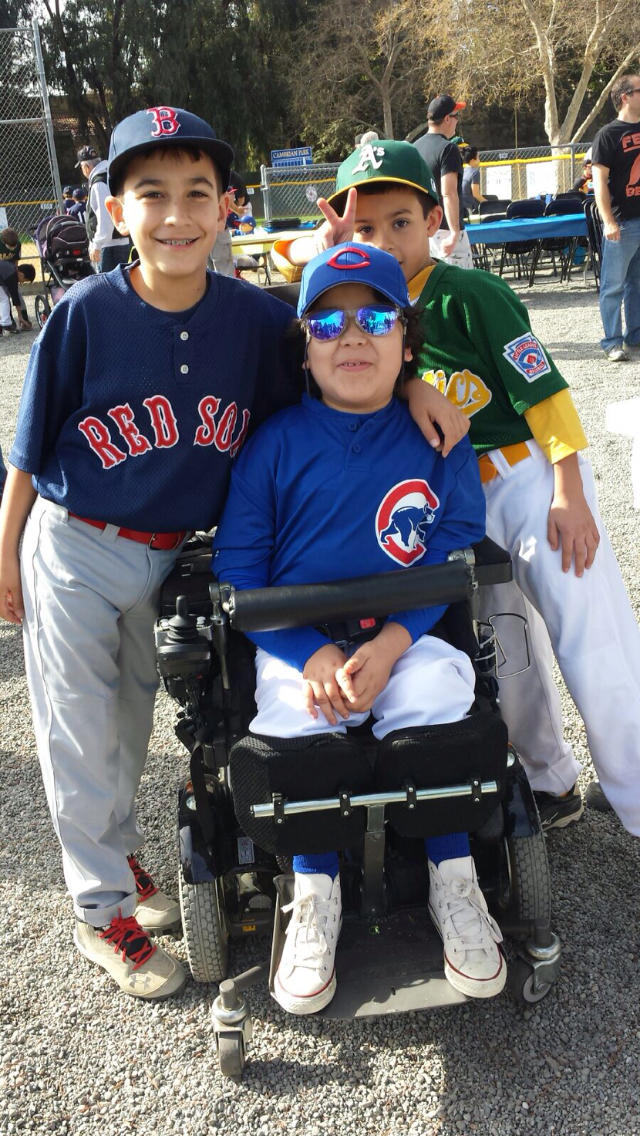
Alejandro and his buddies George and Diego

It was rewarding to the say the least. This was a Challenger league game. The little boy I work with, Alejandro, has Spinal Muscular Atrophy and this league caters to athletes who are differently abled. At every game his team is paired with a Cambrian Little League team and they work together to ensure that all kinds of kids get the chance to experience the magic of baseball. Every Challenger athlete has a partner from a Cambrian team who helps them execute any skills they may have difficulty with. The kids on both sides are learning so much more than the game of baseball; their involvement in these leagues is shaping their perspective on the world and those who inhabit it with them. They are learning skills and gaining knowledge that will drive them in successful directions throughout life. These kids are walking away with the essential life lessons that youth sport should instill in all of its participants. Well done San Jose, well done. (Original article: An Unforgettable Atmosphere)

I am so proud to say that my hometown of Petaluma finally has its very own Miracle League; a baseball league where differently abled athletes are embraced and celebrated. For the past two weekends I have found myself re-living that inexplicable happiness that I first felt in San Jose watching the Challenger League. My heart is beyond full that I have the opportunity to volunteer with such an incredible program right in my own backyard. I urge you to get involved so you can witness the magic for yourself. Thank you to all who have made the miracle league possible; it is the greatest reminder of what youth sport should be all about.

Check out all they have to offer! North Bay Miracle League

“Everyone deserves to experience joy and community through baseball.” – Miracle League Vision.

Shout out to the Volunteer Parent-Coaches!

Posted on

It’s that time of the year! In my opinion, it’s the most wonderful time of the year—sorry, Christmas! Recreation baseball and softball leagues are swinging into gear all over the place. Kids are trying out their new gear, ready to swing for the fences… and parents are praying that someone else is going to volunteer to coach the team! Ha!

This post is a shout-out to you parents who stepped up and volunteered to coach the team.

This post is for all those parent-coaches who aren’t sure where to start and may be wondering what in the world they got themselves into. Let me start by saying—we appreciate you stepping up and “taking one for the team” so all of our kiddos have a place to play and fall in love with the game! I know how hard the position of coach can be, especially if you have little to no experience with the game.img_7376-2

A family friend of ours is in your shoes. He stepped up to coach his son’s baseball team this season, and baseball isn’t his number one sport; he’s more of a football guy. He asked me for help with practice plans and basic mechanics. I wrote out a few practice plans for him, and I thought some of you could benefit from them as well! They tend to just throw you guys into the fire without any guidance, and I’m not down with that. Here are a few practice plans to help you get your season started. (They are written for kids around 8 years old with little to no baseball/softball experience)

Practice 1: Setting the Tone

Practice 2: Intro to Hitting

Practice 3: Infield/Outfield

Practice 4: Eye on the ball

Practice 5: Intro to Game Situations

But He Didn’t Get a Hit…

Posted on

I wanted to write a follow-up article to my original “My kid is in a slump, what do I do?” post. If you haven’t checked out that post yet, you can read it here: My kid is in a slump, what can I do?

I had a parent come back to me after reading that blog and discussing it with me. She described her son’s latest plate performance: “He got two at-bats. He was hit by a pitch and walked. He didn’t swing one time! He’s so timid up there and lacking confidence!”

I went to the checklist:

  • Did he have a positive mindset?
    No. She reported that her son was worried about getting a hit.
  • Did he have strong body language?
    A little yes and a little no.
  • Did he swing at the correct pitches?
    He didn’t swing at any of them!

My next question was: how many of those pitches were strikes? The mom explained that the pitcher was young and just learning, so the umpire gave him a very large strike zone. The strikes that were called against her son weren’t technically strikes.

  • Did he swing well?
    N/A.

photo-1490326149782-dd42fa59bd9f.jpeg

I took into account that her son is 7 and gave her a different perspective.

Her son did exactly what he was supposed to do at the plate. He was patient and demonstrated self-control. He didn’t swing at pitches that were balls and got on base because of it! He reached first twice! That’s productive for his team! (As this athlete progresses, yes, they must learn to adjust their strike zone a little bit to match the umpire’s.) At 7 years old, this at-bat was a total success!

This is an at-bat that can be used to boost his confidence. He helped out his team by demonstrating self-control at the plate and having a good eye. He was productive! He added two base runners to the game! Using this outlook consistently will naturally help him develop a more positive mindset and stronger body language because he will feel successful more often.

I decided not to address his lack of mental and physical confidence at the plate because he is currently feeling very defeated in his baseball performances. This wasn’t the right time to “coach him up,” so to speak. At this stage in the game, I suggested that she simply work with him to have a positive mindset and a strong presence at the plate in their next practice session. Reflecting on this past performance and making him aware that he didn’t have either of those things won’t be helpful in this moment.

Being successful at the plate doesn’t always translate into getting a hit. The younger the athlete is, the harder it is for them to understand this. Keep using this checklist with them and watch their confidence grow as they begin to realize how tangible success is!

Catastrophic Failure: The Power of Pausing and Reflection

Failure is taboo in our culture. We hide from it. We brush it under the rug. We are taught that accepting it is weakness. We are urged to get back up, dust ourselves off, and try again.

I’m curious—is that always the best? Just dust yourself off and keep going? Does the rate at which we get back up and try again matter? Does it have to be immediate?

I believe that sometimes, it’s best—for your heart, your soul, and your growth—to pause. To pause and let the failure sink in. Reflect on it. Truly feel it throughout your whole being. Analyze it and determine its worth and meaning in your life.

IMG_4489.jpeg

Over the past year, I’ve experienced some BIG failures. We’re talking Category 5 storm-type failures. Let me tell you—they knocked me down and obliterated my heart. They were excruciating to swallow. They were hard to understand. The embarrassment was smothering. It felt impossible to accept that they happened. I couldn’t fathom dusting myself off and going back for more. Fails of this magnitude make your body cringe and your skin crawl.

I truly don’t think it was best for me to quickly dust myself off and get back in the game. I needed to take a long, hard look at why I failed and what I wanted my successes to look like going forward. Sometimes, failures are so catastrophic they make you question who you are. I needed to understand what part of that failure was mine to own, and which parts I could release to others.

Was there more to my self-worth?
Could I find passions in other realms to fill my self-image?
Was I enough?

In the midst of the storm, I needed to decide who I was—despite the failures.

With time, perspective sets in. You get to see the reality without the emotion. It’s no less devastating, but your heart comes back to fight for you, and it allows you to put the failure in its place. It allows you to see it for what it really was. It allows you to take the lessons learned and simply leave everything else.

Failure can be devastating, but it isn’t everything. We all fail. Everyone fails. It’s not as taboo as our culture makes it. Without failure, there would be less understanding, less learning, and less perspective-taking. Failure is imperative in any journey. You need it.

For catastrophic failures, let them sink in. Don’t get swept up in the belief that you’re weak if you take a moment to breathe. Allow yourself the time needed to check in with your soul—decide what the failure(s) mean to you. File them where they fit. Grow from the lessons. Tiptoe back out there when your heart is ready, and merge into your lane with a new outlook.

Find those who are rooting for you and embrace them every step of the way.
Or don’t. Maybe your reflections will lead you to a completely different path entirely. Either way, it’s okay.

When faced with a catastrophic failure that shakes your whole being—take care of you.
Listen to your heart and make the decisions you need to feel like you again.
Don’t be pressured by the labels of society.

You are not weak.
You are not a failure.
You are you—and that’s something worth taking care of.

My kid is in a slump, what can I do?

Slumps are tough for kids. They begin to feel like no matter what they do, they’re never going to get a hit.

It tends to snowball into more of a mental hang-up than a physical one. As parents and coaches, we know that dips and peaks in performance are normal—especially for our young athletes. So what can you do to help them get out of their funk before the negative mindset tarnishes their confidence?

To help them regain confidence in their athletic abilities, it’s helpful to reframe their definition of success at the plate by focusing on what they can control.IMG_3948

The goal shouldn’t be to get a hit—because technically, you’re not in control of that. There are too many factors at play: umpires, pitchers, fielders, scorekeepers, etc. Instead, the goal should be to have a good or productive at-bat.

What does having a good at-bat look like?

1. Productive mindset.
This is a huge concept with many ways to instill it, but I’ll try to keep it simple. Explain to your athlete that their thoughts need to help them succeed. They can’t just let random thoughts wander through their mind at the plate—nor can they allow negative thoughts that hinder performance.

Their thoughts should be intentional and productive—designed to help produce the outcome they want.

Have them come up with three things they can say to themselves in the on-deck circle and in the batter’s box that will lead them toward success. Include a mix of confidence boosters and mechanical cues.

Examples:

  1. I’m a powerful hitter.
  2. Keep my hands high.
  3. Keep my weight back.

Or:

  1. Step early.
  2. I’m a great baseball player.
  3. See it and crush it.

Make sure these statements are phrased in an outcome-focused way. Encourage them to say what they want to do—not what they want to avoid. For instance:
Keep my hands high
Don’t drop my hands

img_3950.png

2. Strong Body Language.
Strong body language is a much more tangible expectation than simply saying, “Make sure you look confident at the plate.” Have your athlete practice both strong body language and weak body language so they can clearly understand the difference and the expectation.

3. Swinging at the Right Pitches.
Batters never get to choose which pitches are thrown to them, but they can choose which ones to swing at. Swinging at good pitches is imperative for having a productive at-bat.

4. Swinging Well at Those Selected Pitches.
They’ve chosen which pitches to swing at—now they need to swing well at those pitches. Did they use the proper hitting mechanics that their hitting coaches have been instilling in them?

Use these things as a checklist after every at bat.

Did you have a productive mindset?

Did you have strong body language?

Did you swing at the right pitches?

Did you swing well at those pitches?

You can do this with them in the backyard or at the cages to instill the habit and begin shifting their perspective on success. Practice “real” at-bats with them. Before each at-bat, make sure to give them time to go through their 3 mental statements. It may help if you do it out loud with them.

Then, have them step into the “box” with strong body language. After each at-bat, go through the checklist with them. Use the no answers as moments to coach and improve. Use the yes answers to deliver well-deserved praise!  img_3949.png

Focusing solely on the things they can control makes success feel more tangible. When hitters, especially kids, are in a slump (side note: don’t use that word when speaking to them about their performance), getting a hit can feel like something that happens by chance. It feels as if all these factors have to magically align before they can finally get a hit. They often relate it more to luck than talent.

By focusing on the controllable things, they’ll feel more confident because they will begin to realize that they play the biggest role in their success at the plate.

WARNING: This isn’t an overnight fix. Changing their definition of success takes consistency and time. I urge you to try and always use this language when talking about hitting with them. Your language will shape the language they use in their heads with themselves. By speaking this way about hitting, they can use their hitless at-bats as learning opportunities, because there are specific things they can change or fix.

When they do get a hit (which they will, because they are focusing on the process—which is how hits happen), they will well up with confidence because they’ll know it wasn’t chance or luck. It was their deliberate hard work.

I Chose to Play Anyway

As adults, we have the ability to see the big picture. We know that our decisions, actions, and behaviors will play a role in our future lives. We may not know the size of the role or the type of role, but we are able to foresee the possibility of an impact. We’ve earned that perspective.

As an adult myself, I am often surprised by the reality of that impact once the future arrives in my present, especially for those past decisions that have made a significant impact on my current present. Even with a decent amount of life experience under my belt, it’s hard to understand how my future self will cope. It’s hard to empathize with the struggles that haven’t happened yet; it’s hard to feel the pride in the victories that are yet to come. When the future arrives in my present, the reality feels more overwhelming than I originally imagined. Time and time again, I am surprised that decisions and circumstances that felt so small can seep so deeply into so many different facets of my life.

As hard as it can be for adults to take into consideration how our present selves can impact our future selves, for children, it’s even harder. They haven’t had enough time to understand the big picture. They are still trying to figure out how to function as a human. The present is overwhelming enough as it is; they don’t have the resources to consider the future.

When I was a freshman in high school, I had earned a spot on the varsity softball team. I had hopes of playing in college, and this was an exciting stepping stone to one day meet that goal. Towards the end of my sophomore season, I started to feel a pain in my throwing shoulder. It progressively got worse as the season went on, and by the time tournament ball was well underway, I knew something was wrong. My heart was dedicated to my teammates, and my eyes were fixated on my dreams of playing in college. Through the lens of my young perspective, admitting I was hurt would only disappoint my coach and crush my collegiate dreams. I kept playing without complaint until midway through my junior season of high school ball. The pain was constant, and I had lost significant strength. Being a pitcher, the change in my performance was obvious. I finally had to admit what I had been dealing with. It turns out I had frayed the labrum in my shoulder and would need surgery to rivet it back onto the bone. Due to the timing of the surgery and the length of the recovery process, I lost out on my biggest recruiting season. I was angry, brokenhearted, and defeated. These emotions served as my motivation to make it back on the mound for my senior high school season. I raced through the recovery process, fought through the pain, and started my senior season alongside my teammates. The next year, I ended up playing for the local Junior College team. My dedication to the sport and my teammates continued; I allowed my coach to overuse me on the mound even though I knew it wasn’t best for my shoulder. It didn’t matter to me. My teammates and our performance mattered to me. I would have done anything to contribute to our success, even if it meant sacrificing my health. Finally, in my junior year, I made it to the big leagues; I finished my collegiate career playing for a Division II state school.

I may have achieved my goal of playing collegiate softball, but my shoulder was never the same. To this day, I deal with aches, pains, and losses in strength and mobility. There are activities and experiences I avoid because I know they will cause pain to my shoulder. Simple things like shopping—moving hanging clothes across a rod, holding my cell phone up to my ear to have a phone conversation, or cradling a baby—all irritate my shoulder.

Dedicated athletes, especially young dedicated athletes, are nearsighted. Their whole world is in the present. It’s hard for them to fathom their life after sports. In their eyes, that life doesn’t matter unless they perform right now. Is that dedication to the sport, their teammates, and their dreams beautiful? Absolutely, without question. Is it also concerning? I think so. Especially when you take into consideration injuries that affect the brain, like concussions. I feel lucky that my injury was simply to my arm and not something as sacred as my brain.

The culture of competitive sports often puts the success of the team before the health of the athlete, or even the coach. Those who miss practices or competitions to heal their bodies are often portrayed as weak or less dedicated. It’s almost as if sport forces us to ask our bodies for forgiveness rather than permission. We take fewer preventative measures because we don’t want to miss out on the present. This culture of pushing our bodies to the limit is so deeply rooted in our hearts as athletes. If you play through the pain, you are elite, you are dedicated, you are tough. You are tough. This seems to be the ultimate compliment an athlete can receive.

I still struggle to listen to my body when it comes to competitive situations. I still push myself farther than I should. It’s easier for me to see the big picture for others. I can help my athletes make healthy decisions; I can help my friends make healthy decisions. For myself, however, it’s a different story. I am still influenced by the athlete mentality; I am still deeply committed to proving my worth. To prove my dedication, my abilities, my toughness.

Was it all worth it? That’s a question I still can’t answer. As most athletes say: I wouldn’t change my decision, I would do it all over again in a heartbeat. It’s baffling, isn’t it? Even in hindsight, knowing the consequences, we still choose our sports career over everything. It is an extremely influential culture.

When I began to write this, I wasn’t sure where I was going to end up. I wasn’t sure if there was going to be an answer or a final message. I guess it brought me to awareness. Everything starts with awareness. As coaches, parents of athletes, and athletic directors, we need to be aware of how influential the culture of sport is in our athletes’ lives. How influential we are in our athletes’ lives. Athletes themselves need to recognize how influential sport is in their lives. How much it’s socialized into them. Sport makes a lifelong impact. The lessons athletes absorb and the things they learn to value are deeply rooted in the soul of who they become. We need to always be aware of their future selves. We need to be aware of the imprints we are leaving on their hearts and in their paths.

Explicit Direct Instruction

I am now in my second year of teaching special education. My experiences and schooling have bettered my understanding of how students learn, and even how athletes progress. In teaching, there’s a rule that states, “Don’t ask your students to do anything you haven’t taught them yet.” In coaching, this happens constantly. Coaches move right into hitting fly balls or turning double plays in the first few practices without covering the basics of what they’re looking for. I remember watching a coach run a fly ball drill, and each athlete wasn’t performing as the coach had expected them to. A majority of the players weren’t using the correct footwork to move to the ball. At this particular practice, they had a college player as a guest. This player was executing the drill properly, dropping her hips and crossing over to move to the ball. She was eventually highlighted to the other girls, and immediately everyone’s performances improved. The rest of the team suddenly understood what was expected of them, and they were then able to perform properly.

There is a simple way to integrate teaching skills before asking them to be performed — setting objectives. In teaching, it is best practice to have the objective of the lesson written on the board: “Today we will determine the greatest common factor between two numbers.” After reading over and explaining this to students, they are aware of what the goal is and why they are completing the work at hand. With this information, they can self-monitor their progress throughout the instruction. It gives their work purpose and also helps the teacher keep each lesson focused and productive. In the coaching world, this best practice can easily be implemented; it just looks slightly different.

Before each drill, coaches share what they are looking for with their athletes. For instance, when base running to first base, a coach may explain to their athletes: “I’m looking for you to hit the front of the bag. I am looking for you to immediately break down and look right (for a passed ball). I am looking for you to run on your toes and pump your arms straight back and forth.”

As the coach is going through this checklist, they should also be demonstrating each aspect so the athletes know exactly how to execute the drill. This is beneficial even for the things that seem simple. For instance, there are multiple ways to break down after hitting the bag. Be explicit with your instruction and demonstration. Make sure your athletes know that you want their hips to drop while their head turns sharply to the right after hitting the bag, allowing them to stop in an athletic position just a few feet past the bag. Go through each objective and make them repeat it out loud:

Coach: “I am looking for your foot to hit the front of the bag. What am I looking for?”
Players: “Our foot to hit the front of the bag.”
Coach: “I am looking for you to break down and look right. What am I looking for?”
Players: “Us to break down and look right.”

Experiencing skills in multiple forms helps them grasp new expectations and skills. I always make my athletes see it, hear it, say it, and do it. Making your athletes say the skill out loud helps to prime their brains and bodies for the movements; it helps them remember the skill and execute it. After you have gone through these directions with them a few times or a few practices, it is something you can do quickly and easily before each drill. The coach can simply ask, “What am I looking for?” The players should be able to easily repeat the objectives of the drill.

After I began using this strategy with my players, it immensely improved the focus of our drills. My athletes explicitly understood what I was expecting of them, and they were able to comply. They now had a rubric for their performance.

Quote of the day:
“You haven’t taught until they have learned.” — John Wooden

3 Steps Back, 4 Steps Forward

Posted on

I’ve noticed a common thread among the athletes I’ve had the pleasure of coaching over the past year. Most of them have this fear, or inability, to slow a skill down and adjust in the midst of their mechanics. For instance, the other night I had my team running agility patterns on ladders. Some of the footwork patterns are a little tricky; a few of my girls were having a hard time finding the rhythm. Over and over, my assistant coach and I advised them to slow down, learn the pattern, and not worry about speed. We were looking for quality, not quantity. Even with that instruction, all my girls sped through the ladder, missing sections, and tangling the ladder around their feet.

They are so focused on the outcome and the pace of their teammates around them that they won’t take the time to adjust and learn the skill correctly. Instead, they strive merely to “keep up” with everyone else. It wasn’t until I physically stood beside them and wouldn’t let them go any faster than I was going that they were willing to slow down and talk themselves through the pattern.

This same pattern presents itself when I’m giving pitching lessons. My pitchers are more concerned with throwing strikes than properly executing the mechanics. When we are working on making adjustments, their focus is on the speed and accuracy of the pitch. They don’t allow themselves to be vulnerable and change their movements, which may, in turn, negatively impact their performance — at least for the moment. I’ve spoken to all of my athletes about this, and I haven’t quite gotten to the bottom of what causes it, but I have a few theories that I believe all converge to create this insecurity of not being good enough.

Social Media: Social media has played a huge role in how our athletes view themselves. Their self-confidence is built around how many likes their pictures receive or how many followers they have. They live, eat, sleep, and breathe this superficial culture every day; it constantly reinforces the idea that they are in competition with everyone around them all the time. They must look “good” or “pretty” in order to be accepted socially by their peers. I believe this attitude has carried over to the ball field. I asked my pitcher the other night why she was unwilling to make an adjustment and possibly let the ball go sailing over the catcher’s head. Her response: “There’s a lot of people watching me, and I don’t want them to think that I’m not good.”

Lack of trust in the process: I believe that sometimes athletes struggle to change their swing or mechanics because they simply don’t believe that it will make them better in the long run. Yes, their performance may suffer for a couple of pitches, or a couple of days, or even a week, but if they make the adjustment, it WILL make them better in the long run.

The athletes I’m working with don’t seem to understand this process; they view failure as a negative all the time, even when it’s helping to improve their mechanical game. I think it also comes down to trusting your coaches — trusting that even if your performance suffers momentarily, your coach’s adjustments will improve your performance over time.

Insecurity: Vulnerability is something that isn’t embraced in our society. In fact, it’s shamed most of the time. It makes sense that our athletes aren’t willing to be vulnerable during practice. They aren’t willing to drop their guard and try something that may make them look “silly” or different. They want to be “on” all the time.

It’s imperative for our athletes to be comfortable trying new things. They need to trust the process of taking three steps back if it means they get to leap four steps forward.

Baring it all

My world from my perspective.

One Game, One Love.

Coaching perspectives and life lessons of a Sports Psychology M.A.

Live Love Sport

Improving your mental game

Secret Life of a Startup

Some things you can't complain about at work

M I Initiatives

Belief in Human Potential